
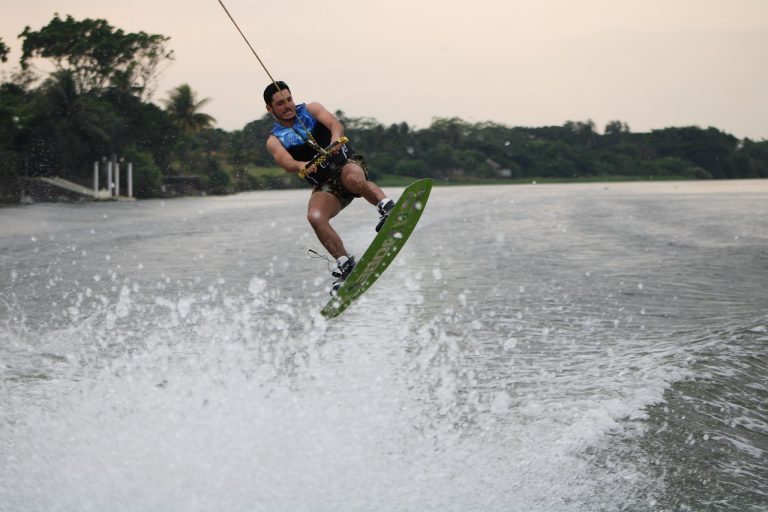
Wakeboarders love trying to do new, exciting tricks on the water. If you’re new to wakeboarding or want to learn more moves, here are some wakeboarding tricks for beginners (or experienced wakeboarders) that you can attempt:
Common Wakeboarding Tricks for Beginners
1. Ollie
In wakeboarding, an ollie is about jumping without help from the wake. It’s a basic skill that you can expand on to perform more complex tricks. To perform an ollie, push down with your back foot and then jump. This makes the board pop up from the water.
2. Grab Tricks
With grab tricks, the rider takes hold of the wakeboard while up in the air. These stylish tricks get their names from the places on the board that the rider grabs. Popular grabs are the Indy, where the rider grabs the toe edge between the feet with his rear hand, and the Tail Grab, where he grasps the board’s tail end.
3. Spins
Spins are a vigorous aspect of wakeboarding, where the basic spin is a 180-degree turn. More skilled riders can try 360-degree spins or even more complex ones.
The secret to performing a good spin is to start the move with the shoulders and head, looking in the direction you want to spin.
4. Inverts
Flips or inverts are tough tricks in which the rider becomes airborne and turns upside down. The rider needs to jump well off the wake and control his body carefully. Among inverts, the Tantrum—a wakeboard backflip—stands out as a favourite.
5. Slides
In slides, the rider slides his board across the water’s surface or an obstacle, such as a rail. The simplest form is the Board Slide, where he turns the board 90 degrees to glide on its side.
6. Raley
The Raley is an amazing move where the rider flings the board behind him in the air, almost parallel with the water, then snaps it back under his feet to land. This move needs good timing, confidence and a solid edge.
7. Wake Jump
In the Wake Jump, the rider uses the wake to launch into the air. A good approach, edge and pop are super important to achieve height and distance.
This list of wakeboarding tricks comprises some of the trick possibilities in wakeboarding. You can modify each move and combine it with others to form new variations, which keeps the sport vigorous and exciting. Remember that staying safe is most important, so always practise with a spotter and wear the right safety gear.
Learn these 7 wakeboarding tricks for beginners with some helpful tips:
Advanced Wakeboarding Tricks
Wakeboarding is about pushing your limits and performing impressive tricks that defy gravity and demonstrate your skill. Once you’ve mastered some of the wakeboarding tricks for beginners and are ready to upgrade your skills, the following advanced wakeboarding tricks should give you an adrenaline rush.
1. Tantrum to Blind
This visually-impressive trick combines a Tantrum (backflip) with a 180-degree Blind rotation. As the rider approaches the wake, he performs a Tantrum while simultaneously rotating his body and lands facing the opposite direction. He needs to time and control his moves precisely for a successful landing.
2. Whirlybird
This advanced trick combines a Tantrum with a 360-degree spin. The rider takes off heelside, flips backward and spins 360 degrees, all in one smooth motion. A successful maneuver displays a high level of technical skill and is always a crowd-pleaser.
3. Front Flip
As the name of this trick implies, the rider performs a flip in the forward direction. He approaches the wake toeside and flips forward, tucking his knees and rotating his body to complete the flip and land. This is a difficult trick that requires a strong pop off the wake.
4. Elephant
The Elephant trick combines a front flip with a 180-degree turn. The rider approaches the wake toeside and performs a front flip while turning his body to face the boat as he lands. The name of this trick derives from the way the rider’s arms resemble an elephant’s trunk during the rotation.
5. Crow Mobe
The Crow Mobe combines a toeside front roll with a 360-degree handle-pass spin. This is another complex maneuver that requires the rider to have excellent control of the rope as he flips and spins.
6. Heelside Mobe
Similar to the Crow Mobe, the Heelside Mobe combines a heelside back roll with a 360-degree handle-pass spin. The rider takes off heelside, flips backward and spins while passing the handle behind his back to complete the rotation.
7. Wrapped KGB
The Wrapped KGB trick combines a heelside back roll with a backside 360-degree spin, all while he is wrapped up in the rope. He, therefore, starts with the rope behind his back and unwraps during the trick to complete the spin.
These are advanced wakeboarding tricks and are not for the faint-hearted. They require much patience and practice and a readiness to take risks. However, for the courageous, the rewards are boundless. As always, prioritize wakeboarding safety and never attempt any tricks without appropriate training and supervision.
Pin this image on Pinterest:
Pinterest image by Ron Lach